Ask five web designers what a website costs and you'll get five answers between £300 and £15,000. Most of that spread comes down to three things: who writes the words, how many pages there are, and what happens after launch. Once you know which of those you're paying for, quotes get much easier to compare.
Below are the rough ranges you'll see quoted in the UK right now, what pushes a price up, and the yearly costs that tend to get left out of the first conversation.
The short answer
For a typical small business site (5 to 10 pages, a contact form, your services and some proof of your work), expect roughly:
| Route | Typical upfront cost | What you're really paying for |
|---|---|---|
| DIY builder (Wix, Squarespace and similar) | £0 upfront, then a monthly plan | Templates and hosting. You supply the design decisions, words and photos. |
| Freelancer | £500 to £3,000 | One person's design and build time. Copy is often extra. |
| Small studio | £1,500 to £6,000 | Design, build, usually copywriting and SEO setup, and someone to call afterwards. |
| Larger agency | £8,000 and up | Strategy workshops, bigger teams, account management. |
These are ranges, not rules. A freelancer with a strong portfolio can charge studio prices, and plenty of agencies will take on small projects. What matters is what's inside the number.
What actually changes the price
Who writes the words
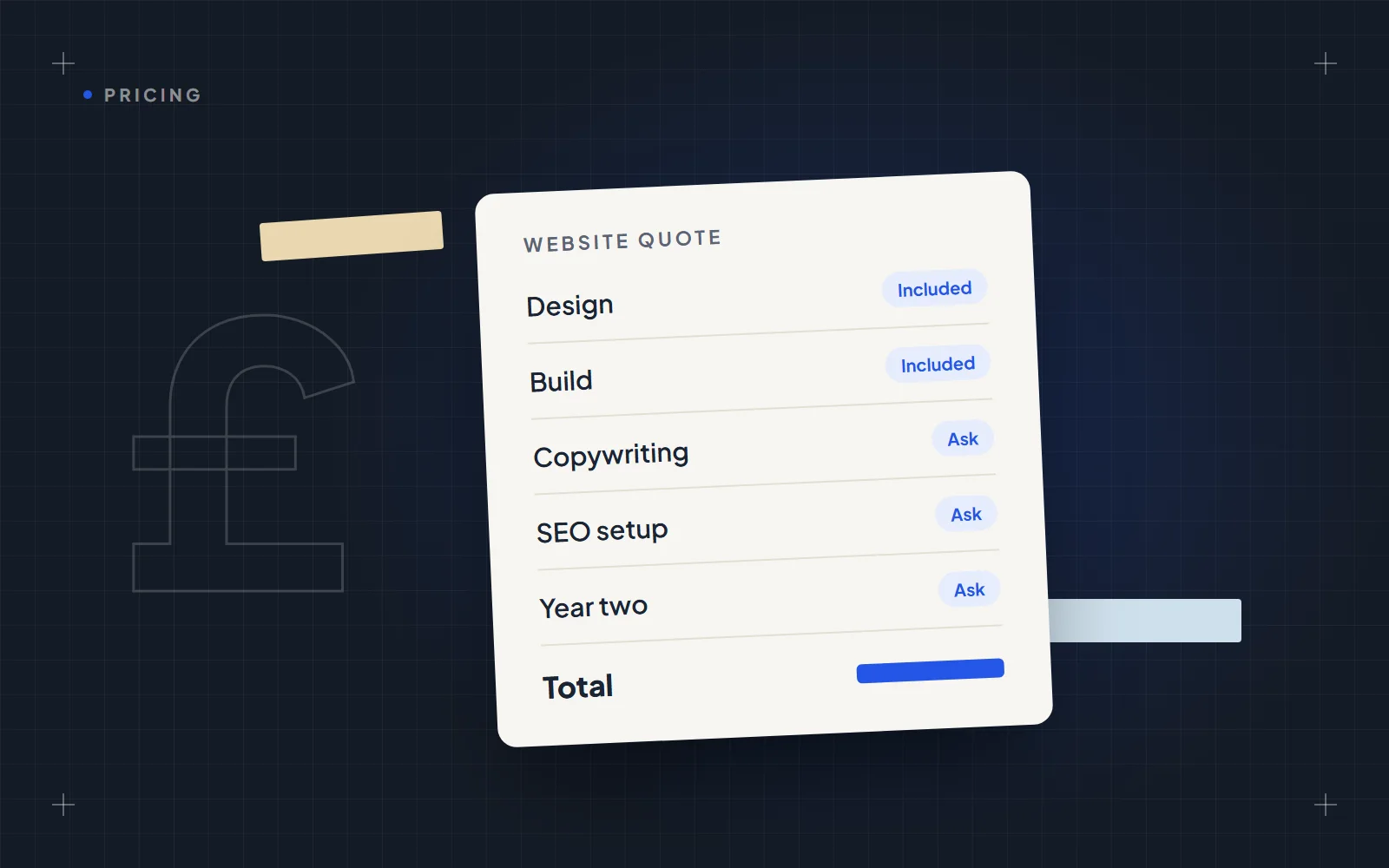
This is the biggest hidden variable. Many quotes assume you'll send over the text for every page. In practice, most business owners don't have it, so the project stalls for weeks while you write it, or the site launches with placeholder copy. If a quote doesn't say "copywriting included", assume it isn't, and budget either your own time or a few hundred pounds extra.
Number and type of pages
A homepage, about page, services page and contact page is a very different job to 15 individual service pages, a blog and a gallery. Each unique page layout takes design time. Pages that reuse an existing layout (for example one page per service) are cheaper to add.
Selling online
A shop adds product pages, a basket, payments, delivery rules and stock. Even a small catalogue usually puts a project into the higher end of each range above.
Integrations
Booking systems, CRMs, quote calculators and client logins all add build time. A simple "book a call" link to a calendar tool is cheap. A custom booking flow that checks your availability is a separate project.
Custom design or a template
A template-based site is quicker and cheaper. A custom design costs more because someone is designing your layouts from scratch, but it means your site won't look like every other business that bought the same theme.
The running costs to budget for
The upfront price is only part of it. Every website has yearly costs, and some quotes don't mention them.
- Domain name: a .co.uk or .com usually costs around £10 to £20 a year.
- Hosting: anything from free (some modern hosting platforms) to £10 to £30 a month for managed hosting. DIY builders bundle this into the monthly plan.
- Email on your own domain: usually a few pounds per person per month through Google Workspace or Microsoft 365.
- Maintenance and changes: this is where costs vary most. Some designers charge by the hour for every edit; others offer a monthly care plan that covers updates, backups and small changes.
Ask every designer you speak to: "What will this cost me in year two if I change nothing?" A clear answer to that question tells you a lot about how they work.
Red flags in a website quote
- No mention of who owns the domain. It should be registered in your name, or transferred to you at the end. If the designer owns it, they own your address on the internet.
- "SEO" with no detail. Ask what they'll actually do. Page titles, descriptions, fast loading, structured data and a sitemap are the basics. "We'll make it SEO-friendly" with nothing else usually means nothing extra.
- Hourly billing with no cap. Fine for small edits, risky for a whole build. You want a fixed price for a defined scope.
- Nothing live to look at. Ask for links to sites they've built that are online today, and check them on your phone.
What a website costs at Sitewright
We keep this simple. A new website is £1,800, fixed, live in 14 days. That includes the design, the build, the copywriting and the SEO setup, so you aren't writing pages at midnight. There's no monthly contract you're locked into. If you want us to look after hosting, edits and SEO afterwards, that's an optional monthly plan you can start or stop.
Before any work starts, we map out every page the site needs and agree the scope with you, so the fixed price stays fixed.
How to compare quotes
Line up each quote against the same list:
- Is the price fixed, and what's in scope?
- Is copywriting included?
- Who owns the domain and the site at the end?
- What does year two cost?
- Can you see live sites they've built?
If two quotes answer all five the same way, pick the person whose past work you'd be proud to have as your own. If they don't, the cheaper quote is usually missing something you'll pay for later.
If you'd like a fixed quote for your site, get in touch and we'll come back within one business day.