Once a website is live, someone has to keep it running. The domain needs renewing, the security certificate needs to stay valid, backups need taking, and every few weeks you'll want to change a price, a photo or your opening hours. Website maintenance is the name for all of that, and UK businesses pay anything from nothing to several hundred pounds a month for it.
The right number depends on how your site is built and how often you change it. Below is what maintenance actually covers, how it's usually priced, and what to check before you agree to anything.
What website maintenance covers
Most maintenance plans bundle some or all of these:
- Hosting: the server your site lives on. Some plans include it, others expect you to pay the host directly.
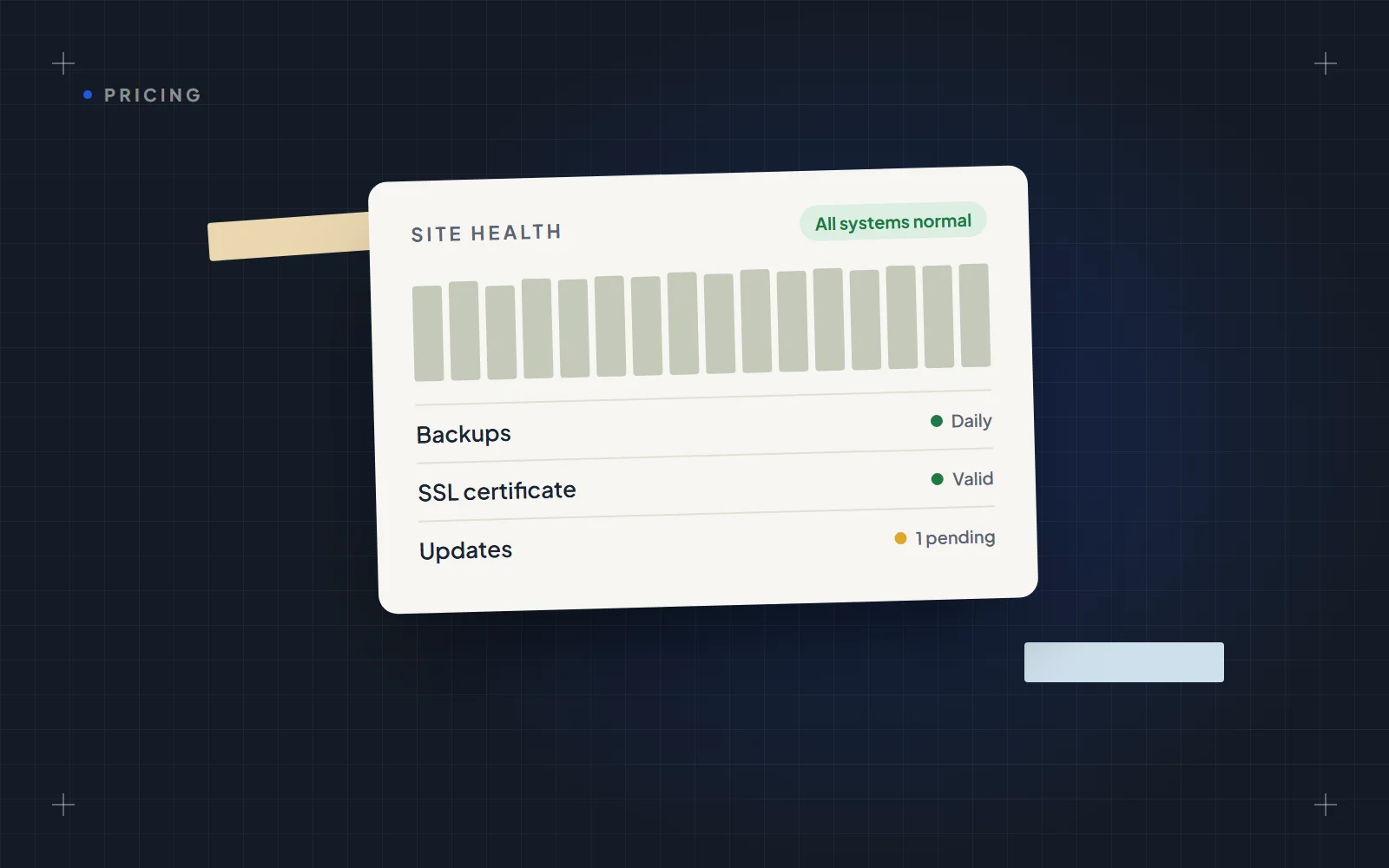
- SSL certificate: the padlock in the browser bar. Most hosts now issue these free and renew them automatically, but someone should check they do.
- Backups: a copy of your site and its content, taken regularly and stored somewhere other than the live server.
- Software and plugin updates: keeping the content management system, theme and plugins on current versions.
- Security monitoring: watching for malware, suspicious logins and known vulnerabilities in the software you run.
- Uptime monitoring: an automated check that alerts someone if the site goes down.
- Small content edits: changing text, swapping images, adding a team member or a new service.
- SEO upkeep: fixing broken links, keeping page titles and descriptions accurate, checking Google Search Console for errors.
Not every site needs all of this at the same level, which is where costs start to differ.
Why some sites cost more to maintain
Older WordPress sites with lots of plugins
A WordPress site built a few years ago with a page builder and fifteen plugins needs regular attention. Each plugin is maintained by a different developer, updates arrive on different schedules, and occasionally one update breaks another. Outdated plugins are also one of the common ways small business sites get hacked. Keeping that kind of site safe means updating carefully, testing afterwards, and having a backup ready to restore. That takes real hours each month.
Modern static or managed sites
A site built as plain pages and hosted on a modern platform has far fewer moving parts. There's no database to attack and no plugins to update, and the hosting platform handles security patches on its servers. Maintenance for this kind of site is mostly content edits, checking it still loads quickly, and SEO upkeep. It costs less to look after because there's less that can go wrong.
If you're paying a high monthly fee for "updates and security", it's worth asking what is being updated. If the answer is "not much", your site may simply not need that level of cover.
How UK designers price maintenance
There are three common models. These ranges are rough and vary a lot by designer and by site.
Pay as you go
You pay an hourly rate, usually somewhere between £30 and £80 an hour, only when you ask for something. This suits a site you rarely change. The catch is that nobody is checking backups or updates between your requests, so problems can sit unnoticed until something breaks.
Monthly care plans
A fixed monthly fee covers hosting, updates, backups, monitoring and a set amount of small edits. Basic care plans commonly run from a few tens of pounds a month up to a couple of hundred, depending on how much editing time is included and how complex the site is. This is the most common choice for small businesses, because the cost is predictable and someone is responsible for keeping the site healthy.
Retainers
A retainer buys ongoing work as well as upkeep: new pages, landing pages for campaigns, regular SEO improvements, design changes. Retainers typically cost several hundred pounds a month or more. They make sense when your website is an active sales tool you want to keep improving, rather than something you set up once.
What to check in a maintenance agreement
Before you sign up, ask for answers to these in writing.
What counts as a small edit?
"Unlimited small edits" sounds generous until you find out that adding a page or changing a layout doesn't count. Ask for examples of what's included and what gets quoted separately.
How fast will they respond?
There's a difference between "we'll reply within one business day" and "we'll fix it within one business day". Ask what happens if your site goes down on a Friday evening.
Where are the backups, and can you get them?
Backups should be stored away from the live site, kept for at least a few weeks, and handed to you if you ask. A backup only the designer can access is less useful than it sounds.
What's the notice period?
Month-to-month plans are easy to leave. Twelve-month contracts lock you in even if the service drops off. Know which one you're agreeing to.
What happens if you leave?
You should get your domain, your site files and your content without a fight. If the site is built on a platform only the designer controls, ask how you'd move it elsewhere. This matters more than the monthly price.
Signs you're overpaying
- You pay for weekly plugin updates on a site that has no plugins.
- Your plan includes editing time you haven't used in a year.
- You can't get a clear list of what the fee covers.
- You're on a long contract for a site you rarely change.
Signs you're underprotected
- Nobody can tell you when your last backup was taken.
- Your site runs software versions that are years out of date.
- You only find out the site was down when a customer tells you.
- Your SSL certificate has lapsed and visitors see a security warning.
- Small changes take weeks because there's no agreement in place.
If any of the second list sounds familiar, the cheapest fix is usually a basic care plan, because restoring a hacked or broken site costs far more than looking after it.
How we handle maintenance at Sitewright
Every new Sitewright site launches with a month of care included, so hosting, backups, monitoring and small edits are covered from day one. After that, ongoing care is optional and runs month to month, with no long contract. Because we build modern, lightweight sites, there's less to maintain, and more of your plan goes on edits and SEO instead of keeping software patched.
If you're working out the full cost of a new website, our guide to what a small business website costs in the UK covers the upfront side. For the monthly side, ask us about care plans and we'll tell you what your site actually needs.