A small business website can go live in two weeks or drag on for six months, and the difference rarely comes down to how fast anyone types code. Most of the calendar goes on waiting: for page text, for photos, for a decision from whoever has the final say, or for someone to remember the login to the domain.
Here's how long each route usually takes, the stages every project goes through, and what you can do to keep yours moving.
Typical timelines by route
These are rough ranges for a 5 to 10 page site with a contact form and your services. Shops and custom features take longer.
| Route | Typical time to launch | Where the time goes |
|---|---|---|
| DIY builder (Wix, Squarespace and similar) | A few weekends to a few months | Your evenings. Picking a template is quick; writing every page yourself isn't. |
| Freelancer | 3 to 8 weeks | Fitting around their other clients, plus waiting on your content. |
| Small studio | 2 to 6 weeks | Mostly set by how quickly copy and feedback come back. |
| Larger agency | 2 to 4 months or more | Workshops, sign-off stages and more people in each decision. |
A quoted timeline only means something if you know what it assumes. "Four weeks" from a designer who expects you to write all the text is really four weeks plus however long that takes you.
The stages of a website project
Every build goes through the same steps, whoever does it. Some take a day; some take weeks if nobody pushes them along.
1. Discovery and scoping
Agreeing what the site is for, who it's for, and which pages it needs. The output should be a page map: a list of every page and what goes on each one. Skipping this step is the main reason projects grow halfway through.
2. Content and copy
The words for every page, plus photos, logos, reviews and any case studies. This stage causes more delays than all the others combined, because it usually lands on the business owner, who also has a business to run.
3. Design
How the pages look: layout, colours, type, and how the site behaves on a phone. If you have brand guidelines already, design moves faster.
4. Build
Turning the design into a working site, connecting the contact form, setting up page titles and descriptions, and making sure it loads quickly.
5. Review rounds
You click through the site and send back changes. Two focused rounds are usually enough. Open-ended rounds are where timelines stretch.
6. Launch
Pointing your domain at the new site, setting up redirects from any old pages, submitting the sitemap to Google Search Console, and testing the contact form with a real enquiry.
7. Post-launch fixes
A week or so of small tweaks once real visitors arrive: a typo someone spots, a phone number that should be clickable, a page that needs a clearer button.
What actually causes delays
Waiting on copy and photos
This is the big one. A designer can have the layout ready in days and then sit for three weeks waiting for the "About us" page. If you're writing the text yourself, start before the project does.
Too many decision-makers
When three partners each send separate feedback on the same page, the designer has to wait for you to agree with each other. One person collecting everyone's comments and sending one list saves days per round.
Scope creep
"Could we also add a booking system?" halfway through the build is a new piece of work. It might be a good idea, but it moves the launch date. Better to launch what was agreed and add the extra feature straight after.
Unlimited revision rounds
Without a limit, feedback drips in one change at a time and the site never quite finishes. A fixed number of rounds makes everyone batch their changes.
Domain and email access
A surprising number of launches stall because nobody knows who registered the domain, or the login belongs to a previous web designer who no longer replies. Find out before the project starts, not on launch day.
How to make your project go faster
- Have your logins ready. Domain registrar, current hosting, Google Business Profile, and the email account they're tied to.
- Name one decision-maker. They gather feedback from everyone else and send it as one message.
- Agree the scope first. A written page map and a list of features means nobody is surprised by the bill or the date.
- Let the designer write the copy. You know your business; a good copywriter can interview you for an hour and turn that into every page faster than you can write one.
- Book review slots in advance. Put two 30-minute review sessions in the diary at the start, so feedback doesn't wait for a gap in your week.
- Gather photos early. Real photos of your team, premises and work beat stock images, and they take time to collect.
What a 14-day build looks like
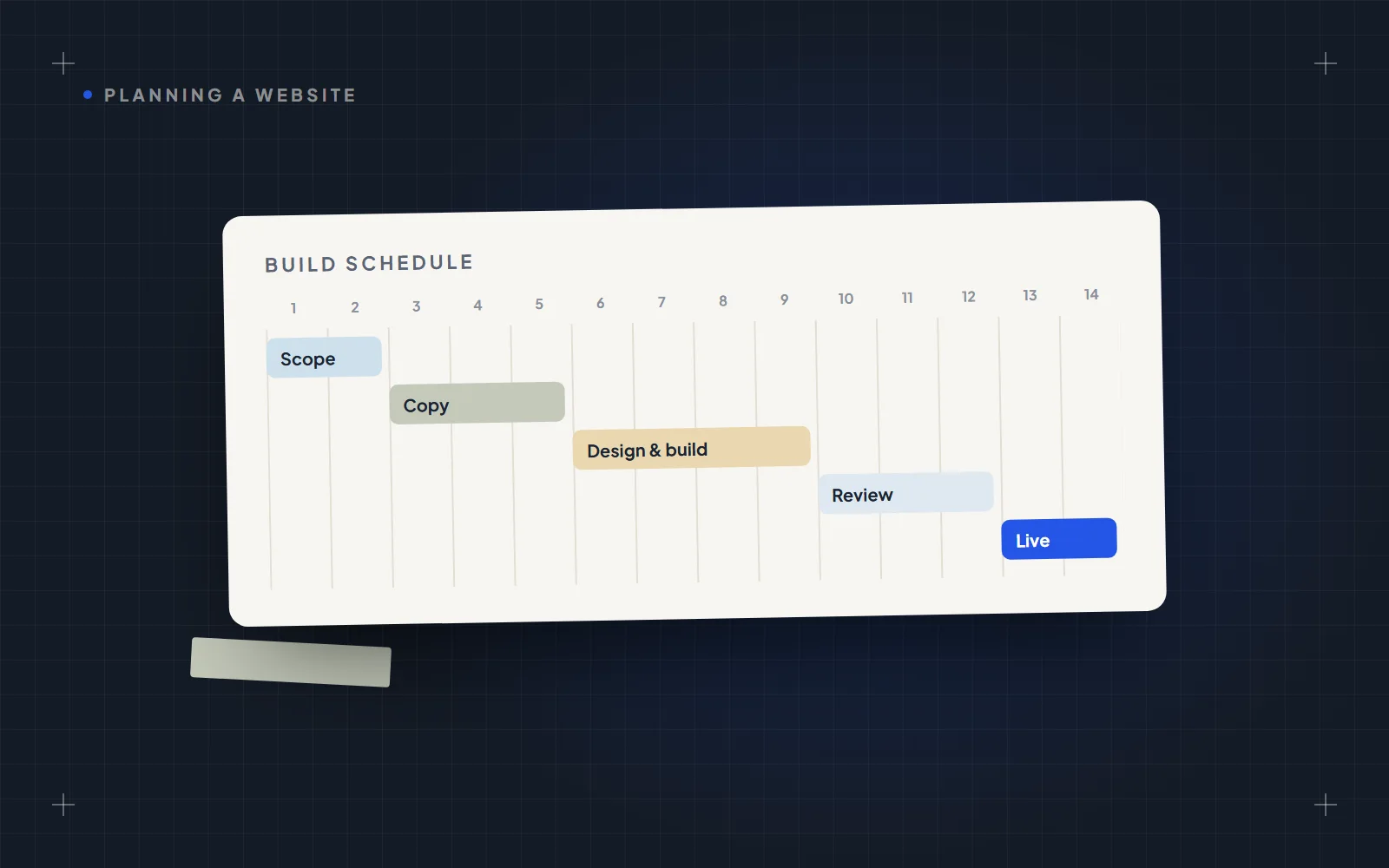
Two weeks is enough for a small business site when the scope is agreed up front and the copy is written as part of the job. Here's how we lay it out:
| Days | What happens | What we need from you |
|---|---|---|
| 1 to 2 | Scoping call and page map: every page and what goes on it | An hour on the call, plus your logins |
| 3 to 5 | Copywriting for every page | A short interview, then a read-through |
| 6 to 9 | Design and build | Photos and logo, if you have them |
| 10 to 12 | Review rounds and changes | One batch of feedback per round |
| 13 to 14 | Launch: domain, redirects, Search Console, form testing | A final yes |
That schedule depends on the scope agreed on days 1 and 2. A five-page site fits comfortably. A 30-page site with a shop doesn't, and we'd tell you that before starting rather than halfway through.
How Sitewright keeps to 14 days
Our websites go live in 14 days because we remove the two things that usually stall a project. We scope every page before any design starts, so the plan doesn't shift underneath us. And we write the copy ourselves, so nothing waits on you finding a free evening to describe your services.
If you're comparing designers, it's worth reading the questions to ask before you hire one, and planning which pages your website needs before you get quotes.
When you're ready, start your 14-day build and we'll come back within one business day.